Case Study: Fading Memory
Each of these brightly coloured sticky notes (Figure 8.1.1) represents a piece of information that someone doesn’t want to forget. Although we are all forgetful sometimes, most people do not have trouble remembering things that are important or routine to them, such as a friend’s name or how to get to class. Our brain — the control centre of the nervous system and the rest of the body — normally allows us to retain and recall information. If, however, the brain is damaged, a person may need to rely excessively on external reminders — like this wall of sticky notes — rather than their own memory… if they can remember to write things down in the first place.
One person having trouble with her memory is 68-year-old Rosa. Rosa has been struggling to remember where she has set down objects in her house, and she forgot about a few doctor’s appointments and lunches she planned with friends. Her family began to notice that she would sometimes fail to recall recent conversations, requiring them to repeat things to her. Rosa would also sometimes struggle to find the right word in a conversation, and would put objects in unusual places, such as the milk in a cabinet instead of the refrigerator. While most people do things like this occasionally, it seemed to Rosa and her family that it was happening to her more regularly.
Rosa also had other symptoms that were impacting her life, such as having trouble paying her bills on time and managing her budget, which she had previously done well. She ascribed these lapses in memory and mental functioning to the normal effects of aging, but her family was concerned. They noticed that she was also more irritable than usual and would sometimes verbally lash out at them, which was not like her. When she became disoriented on a walk around her neighborhood and a neighbor had to escort her home, her family convinced her to see a doctor.
Besides a complete physical exam and lab tests, Rosa’s doctor interviewed Rosa and her family about her memory, ability to carry out daily tasks, and mood changes. He also administered a variety of tests to assess her memory and cognitive functioning, such as her ability to solve problems and use numbers and language correctly. Finally, he ordered a scan of her brain to investigate whether a tumor or some other observable cause was leading to changes in the functioning of her brain.
Based on the results of these tests, Rosa’s doctor concluded that she most likely has mild Alzheimer’s disease (AD). AD results from abnormal changes in the molecules and cells of the brain, characterized by clumps of proteins (called amyloid plaques) between brain cells and tangled bundles of protein fibres (called neurofibrillary tangles) within certain brain cells. The affected brain cells stop functioning properly, lose their connections to other brain cells, and will eventually die. Figure 8.1.3 shows part of a cross-section of a brain from a patient who had severe AD, compared to a similar cross-section of a healthy brain. You can see how severely shrunken the brain with AD is, due to the death of many brain cells.
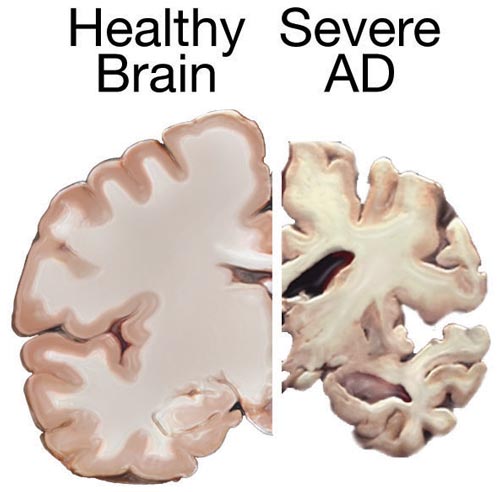 Figure 8.1.3 Alzheimer’s Disease ultimately results in loss of brain cells due to abnormal changes in the molecules and cells of the brain.
AD is a progressive disease, which means the damage and associated symptoms get worse over time. Clinicians have categorized the progression into three main stages — mild, moderate, and severe AD. Typically, AD cannot be definitively diagnosed until after death, when the brain tissue can be directly examined for plaques and tangles. Based on Rosa’s symptoms and the results of her tests, though, her doctor thinks she most likely has mild AD. At this stage, the brain has started changing, but resulting symptoms are not yet severe.
Although there is currently no cure for AD and Rosa will eventually get worse, her doctor says that medications and behavioral therapies may improve and prolong her functioning and quality of life over the next few years. He prescribes a medication that improves communication between brain cells, which has been shown to help some people with AD.
As you read this chapter, you will learn more about how the brain and the rest of the nervous system work, along with the multitude of functions they control in the body. By the end of the chapter, you will have enough knowledge about the nervous system to learn more about why AD causes the symptoms that it does, how Rosa’s medication works, and some promising new approaches that may help physicians diagnose and treat AD patients at earlier stages.
Create a document titled “Nervous System Assessment”.
- Based on Rosa’s symptoms, which parts of her brain may have been affected by Alzheimer’s disease? Explain your reasoning. (2)
- What molecule is involved in sending messages between neurons? Explain the process of the molecule release and uptake. In what ways (more than one) can drugs alter this process? Be sure to watch the videos on page 8 of the chapter for your answer. (5)
- Why can’t Rosa’s brain simply grow new cells to replace the ones that have died? (2)
- Draw and label an outline of the brain. Include a brief description of the role of each part. (6)
- Make a model of a neuron using items such as a pipe cleaner (axon), puffy balls (cell body), tape (myelin), etc. Include neurotransmitters, dendrites as well. Create a video in which you use your model to explain an “order of events” for how the nerve impulse travels. (10)
- Research the effects of nervous system injuries. What have engineers helped develop for persons who have suffered nervous system trauma? (10)
- Try using “nervous system injury and technology” in your search engine. OR
- Select one of the following links:
- New Technique Could Help Repair Nerve Damage
- Helius Medica – PoNS Device
- Electronic Implants & Spinal Injuries
- Neural-Prosthesis & Touch
- Spinal-cord Injuries & Stimulators
- Turning Thoughts into SpeechBrain-Computer Interfaces
- Neuroregeneration (Mayo Clinic)
- People enjoy playing video games that require the proper functioning of the nervous system. Explain the role of the nervous system in playing a video game. Be specific; include the following vocabulary in your explanation: nervous system, central nervous system, peripheral nervous system, brain, spinal cord, dendrites, axon, impulse, synapse, receptors, sensory neurons, motor neurons, interneurons, action potential, neurotransmitters. (16)
The post Case Study: Fading Memory appeared first on PapersSpot.