PSB501EN Assessment Brief
*This document is for CU Group-PSB Academy students for their own use in completing their assessed work for this module and should not be passed to third parties or posted on any website. Any infringements of this rule should be reported to CU_ENG@psb-academy.edu.sg
| Assessment Type: Case Study | Assessment Number: 1 | Study Mode: Part-Time | Weighting: 10 Credits |
| Submission Date: 04/01/2026 | Submission Time: 2359 hrs (Singapore Time) |
💡 Struggling with PSB501EN Mechanical Engineering Systems Case Study?
Native Singapore Writers Team
- 100% Plagiarism-Free Essay
- Highest Satisfaction Rate
- Free Revision
- On-Time Delivery
Introduction:
The solution for “real world” technical engineering problems requires an exercise of interpretation and the adoption of a multi-technique approach to provide adequate outputs to the complexity of the challenges. Assessment 1 seeks to reproduce such challenges through a combined analytical, numerical, and interpretive approach to various scenarios.
- The student should attempt to answer ALL case study
- All solutions should be Marks are not awarded for handwritten work.
- Provide references in APA 7th edition format where
Completion of this assignment will address the following learning outcomes:
| MLO1 | Evaluate the effects of externally static – or quasi-static – applied load (axial load, torsion, bending moment, and shear) on the internal stress state of structural and machinery components. |
| MLO2 | Evaluate the principles of Fluid Dynamics (continuity equation, Bernoulli’s equation, integral and differential forms of the conservation equations) and apply them to systems of fluid flow. |
| MLO4 | Model and solve problems involving energy balance/heat transfer of any mechanical system. |
| MLO5 | Examine the fundamentals of Mechanical Vibrations and their role in dynamics of machinery. |
Task
Case Study: engineering problems requiring analytical or numerical (simulation) solution (1500 words or equivalent).
Students are required to complete three case studies. All questions within a case study must be answered and submitted as a written report.
Instruction:
- Answer all Case studies. Each case study carries different marks, but the total marks for the coursework are 100 marks.
- All solutions should be typed. Marks are not awarded for handwritten
- This is an open-book, take-home assignment; you are allowed to use all resources available to you. All references used need to be appropriately cited. APA style (7th edition) reference formatting. You may refer to the CU library guides at https://libguides.coventry.ac.uk/apa
- In a case study, some questions may be a continuation of the preceding
Viva Voce Requirement:
Selected reports will undergo a Viva Voce (oral interview) to assess the student’s understanding of the Module Learning Outcomes (MLOs). Students invited for the Viva will be required to explain their approach, justify their solutions, and demonstrate their comprehension of key concepts. Failure to attend the Viva or adequately explain the work submitted may result in further academic review.
Acknowledging the Use of AI Tools:
If you have used any AI tools, such as language models or image recognition software, in your assignment or report, please acknowledge their use in your submission. Include a list of the AI tools used, their purpose in your work, and their source. As part of this requirement, please also include the chat scripts of any AI tools used in your work as an appendix to your submission. This acknowledgement is necessary to ensure academic integrity and transparency in the grading process.
Plagiarism -à SI<20%
AI Index less than 20%
Check on Quillbot
Academic Integrity Guidance
The best way to avoid academic misconduct is to follow appropriate academic and referencing conventions. Further guidance on academic integrity and conduct can be found using LibGuides at https://libguides.coventry.ac.uk/academicintegrity
Collusion between students (where sections of your work are similar to the work submitted by other students in this or previous module cohorts) is taken extremely seriously and will be reported to the Academic Conduct Panel. This applies to all coursework and exam answers. If you would like more guidance on understanding collusion, you can find it on LibGuides.
If an assessment suspected of involving a breach of academic integrity is found to display a marked difference in writing style, knowledge and skill level from that demonstrated elsewhere on the course, you may be required to undertake a Viva Voce in order to prove the coursework assessment is entirely your own work.
You must not submit work for an assessment that you have already submitted (partially or in full), either for your current course or for another qualification of this university, unless this is specifically provided for in your assessment brief or specific course or module information.
It is important to realise that as a student you should not submit all or part of an assessment for which you have already received academic credit, to be used for an assessment in a different module. Reusing your own work in this way is called self-plagiarism. Where you wish to refer to some of your own work you must reference it in the same way that you reference work by other people.
CASE STUDY 1 {40 marks} (MLO1)
Hired as a structural integrity engineer, you are tasked to perform the analytical study on the beam structure shown in Figure 1. Each element’s length is 1000 mm, and the Young Modulus of Elasticity is 210 GPa.
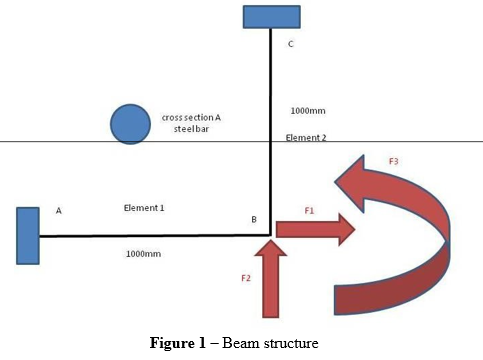
Parameter Input Value: 42
A = 42 × 10 = 420 mm2
F1 = 24 × 100 = 2400 N
F2 = 42 × 100 = 4200 N
F3 = (4+2) × 100 = 600 N-m
Model the given beam structure with the input parameters based on your student ID. Including:
- Create elements and FEA model in computer Simulation (Solidworks – Please save solid works file as 2018 or earlier)
- Apply the Loads and Boundary conditions at
- Run the Computer Simulation FEA solver and examine the Simulation FEA
Analyse and comments the FEA results
Note: If you submit Computer Simulation generated report, you will receive ZERO mark.
CASE STUDY 2 {30 marks} (MLO2, MLO4)
𝑥 = 6
Table 2 – Diameter at point 1 and point 2
| Customised parameter, 𝑥 | Diameter at point 1, 𝑑1 (m) | Diameter at point 2, 𝑑2 (m) |
| 6 | 0.36 | 0.26 |
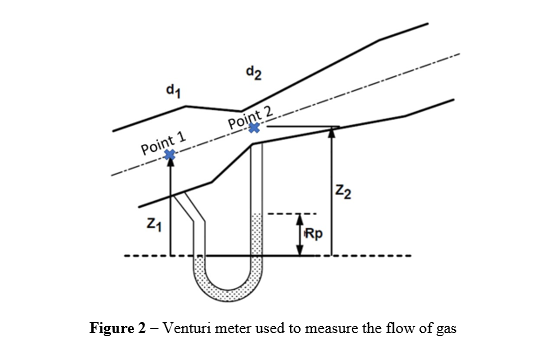
Figure 2 shows a Venturi meter used to measure the flow of gas. You were requested to analyse the output of a pipeline transporting gas for industrial applications. The flow requested at the outlet cannot be less than 0.085 m3/s. Upon checking the measurement instrument, you realise that the pressure difference between the entrance and the throat is measured as 0.06m on a water U-tube manometer. Refer to the table 2 for the diameters 1 and 2 values. Knowing that the specific weight of the gas is constant at 19.62 N/m3 and that the variations in the measured discharge do not exceed 4%, CALCULATE the (a) discharge coefficient of the device; and
(b) the volumetric flow. Is the supply meeting the requirements of the intended application?
CASE STUDY 3 {30 marks} (MLO5)
- Many damped physical systems found in engineering may have their behaviour expressed by second-order non-homogeneous ordinary differential equations (ODEs.) This type of problem involves obtaining the response of the associated homogeneous ODE and a particular solution of the non-homogeneous ODE. The sum of these two provide the general solution of the non-homogeneous Based on this information: what is the physical meaning of the solution of the associated homogeneous ODE.
- Vibrations in rotating machinery, such as turbines, engines, and motors, can significantly impact performance, reliability, and maintenance schedules. Engineers analyse vibration characteristics to prevent resonance, reduce wear, and enhance operational stability.
A rotor system in a turbine is modelled as a single-degree-of-freedom (SDOF) system, consisting of a 4 kg disk mounted on a shaft with an effective stiffness of 36 N/m. The system is undamped and subjected to an external harmonic excitation force given by:
𝐹(𝑡) = 15 cos(3𝑡) 𝑁.
- Determine the natural frequency of the system in
- Calculate the steady-state amplitude of vibration when the system is subjected to the external force 𝐹(𝑡).
- If the shaft is redesigned to have a new stiffness of 64 N/m, discuss how the vibration response would change and its implications for machine operation?
- In real-world applications, damping is often introduced to mechanical systems. Discuss how adding damping would affect the system’s vibration What are some practical methods used to reduce excessive vibrations in rotating machinery?
Note: The consultation of support materials (books, journal papers, conference papers, industrial technical reports, etc.) is strongly encouraged and must follow the guidelines for academic citation.
Guidance notes and considerations Late Submission
If you are not able to complete your coursework on time due to extenuating circumstances, the ONLY
way to receive an extension (up to 5 working days) or a deferral (anything longer than 5 working days) is to contact a School of Engineering and Technology, PSB Academy.
PSB Academy Singapore – CU_ENG@psb-academy.edu.sg
- Extenuating circumstances are defined by CU as ‘genuine circumstances beyond your control or ability to foresee, and which seriously impair your assessed work’.
- Please note that you will need to provide third party evidence to support your reasoning for requiring an extension or deferral.
- Your course tutor is NOT able to approve an extension or a deferral, if you have not completed the official forms and had your request approved your work will count as not submitted and receive a zero
Plagiarism and Malpractice
- You are encouraged to check the originality of your work by using the draft Turnitin links on your Blackboard Web.
- Collusion between students (where sections of your work are similar to the work submitted by other students in this or previous module cohorts) is taken extremely seriously and will be reported to the academic conduct panel. This applies to all coursework and exam answers.
- A marked difference between your writing style, knowledge and skill level demonstrated in class discussion, any test conditions and that demonstrated in a coursework assignment may result in you having to undertake a Viva Voce in order to prove the coursework assignment is entirely your own
- If you make use of the services of a proof reader in your work you must keep your original version and make it available as a demonstration of your written efforts.
- You must not submit work for assessment that you have already submitted (partially or in full), either for your current course or for another qualification of this university, unless this is specifically provided for in your assignment brief or specific course or module information.
Where earlier work by you is citable, ie. it has already been published/submitted, you must reference it clearly. Identical pieces of work submitted concurrently will also be considered to be self-plagiarism.
Format to Follow:
Executive Summary (whole Report)
Problem Statement (per problem)
Introduction
Process/Methodology
- Input Parameters
- Workshow/Flowchart
Results
Comments/Interpretation
Submission Guidelines
There should be a title page which clearly identifies the following;
- Student number * Name of the module
- Title of the Assessment * Assessment number
- Word count
The word count identified includes quotations, but excludes the bibliography and unless specifically stated, encompasses a discrepancy of + or – 10%.
💡 Need Expert Help for Your Coventry University Assignments?
PSB501EN Rubric
| Banding | Knowledge and Understanding
(30%) |
Analysis, Evaluation and Application of Theory
(30%) |
Quality of Research (20%) | Academic Writing (20%) |
| 90-100% | Exceptional knowledge base exploring, analysing and evaluating the discipline and its theory with extraordinary originality and autonomy. | Demonstrates an exceptional grasp of relevant analytical techniques, and the ability to apply these to new and/or abstract information and situations. Shows a highly developed appreciation of the limits and/or appropriate uses of particular analytical and evaluative approaches. Knowledge and understanding of theory, where relevant, is highly detailed. Exceptional appreciation of the limits of theory demonstrated throughout all assessment outcomes. Approach to assessment task is theoretically informed to an exceptional standard. | Exceptional exploration of wider academic sources with a high degree of independent learning which exceeds the assessment brief. Sources have been accurately interpreted and integrated with flawless synthesis, leading to innovative and interesting ideas. With some adjustments, work may be considered for internal publication. | Exceptional answer with coherent and logical presentation of ideas. The answer exhibits a clear argument/line of reasoning with flair and originality. Discipline specific vocabulary used with precision and academic style applied well throughout. No language errors present and referencing in the CU version of Harvard or APA has been employed in an accurate manner. With some adjustments, work may be considered for internal publication. |
| 80-89% | Outstanding knowledge base exploring, analysing and evaluating the discipline and its theory with clear originality and autonomy. | Demonstrates an outstanding grasp of relevant analytical and/or evaluative techniques. Shows a developed appreciation of the limits and/or appropriate uses of particular analytical and/or evaluative approaches. Knowledge and understanding of theory, where relevant, is detailed and
sophisticated. Appreciation of the |
Outstanding exploration of wider academic sources with a high degree of independent learning which exceeds the assignment brief. Sources have been accurately interpreted and integrated with a high degree of synthesis, leading to | Outstanding answer with coherent and logical presentation of ideas. The answer exhibits a clear argument/line of reasoning with flair and originality. Discipline specific vocabulary used with precision and academic style applied throughout. No language errors present. Referencing in the CU version of Harvard |
| limits of theory demonstrated throughout the work. Approach to assessment task is clearly and appropriately theoretically informed. | innovative and interesting ideas. | or APA has been employed in an accurate manner. | ||
| 70-79% | Excellent knowledge base that supports analysis and/or evaluation and problem- solving in theory and/or practice within the discipline, with considerable originality. | Demonstrates a detailed, accurate, theoretical understanding. Appropriately selected theoretical knowledge is applied to the individual learning outcomes. Makes excellent use of established techniques of analysis and/or evaluation relevant to the discipline and applies these effectively. Shows developed ability to appraise alternative theories and/or analytic approaches, where relevant. | Excellent exploration of wider academic sources with evidence of independent learning which may exceed the assignment brief. Sources have been accurately interpreted and integrated with an attempt made at synthesis, leading to interesting ideas. | Excellent answer with coherent and logical presentation of ideas. The answer is entirely relevant and focused with a clear argument/line of reasoning throughout. Discipline specific vocabulary used with precision and academic writing style applied throughout. No language errors present. Referencing in the CU version of Harvard or APA has been employed in an accurate manner. |
| 60-69% | Very good knowledge base that supports analysis and/or evaluation and problem- solving in theory and/or practice within the discipline, with some originality displayed. | Makes very good use of established techniques of analysis and/or evaluation relevant to the discipline. Shows developing ability to compare alternative theories and/or analytic approaches, where relevant. | Very good evidence of wider academic reading and independent learning. Sources have been accurately interpreted and integrated with some evidence of synthesis. | Very good answer with coherent and logical presentation of ideas. The answer is relevant and focused. Discipline specific vocabulary is used and academic writing style applied. Minimal language errors may be present but do not impact on clarity of expression. Referencing in the CU version of Harvard or APA is accurate. |
| 50-59% | Good knowledge base that supports some analysis and/or evaluation and problem-solving in theory and/or practice within the discipline. | Makes good use of established techniques of analysis and/or evaluation, relevant to the discipline. Sound descriptive knowledge of key theories with some appropriate application. | Good evidence of academic reading, with attempt at moving beyond the
recommended texts. Interpretation of sources is acceptable with evidence of integration. |
Good answer with coherent and logical presentation. The answer is largely relevant but lacks focus at points. There is an attempt at using discipline specific vocabulary and academic writing style. Some language errors are present which impacts on clarity at times. Referencing in the CU version of Harvard or APA is mostly accurate. |
| 40-49% | Satisfactory knowledge base demonstrating comprehension and formulation of basic knowledge with some omissions at the level of theoretical understanding.
Limited ability to discuss theory and solve problems within the discipline. |
Makes satisfactory but limited use of established techniques of analysis and/or evaluation, relevant to the discipline. Selection of theory, if relevant to the assessment outcomes is satisfactory but application and/or understanding is limited. | Satisfactory evidence of academic reading, with minimal attempt to move beyond the recommended texts. Interpretation of sources is acceptable, but there may be some instances of misunderstanding. | Satisfactory answer with some attempt at coherence and logical presentation. The answer contains some irrelevant material and lacks focus at points. There is minimal use of discipline specific vocabulary and academic writing style is inconsistently applied. Some language errors may be present which impacts on clarity at times. Referencing in the CU version of Harvard or APA is mostly accurate but with some errors. |
| 35-39%
(Marginal Fail) |
Outcomes not or only partially met. Restricted knowledge base demonstrated. Limited understanding of discipline. Difficulty with linking theory and problem solving within the discipline. | Attempts at analysis and/or evaluation ineffective and/or uninformed by the discipline. Knowledge of theory inaccurate and/or incomplete. Choice of theory inappropriate. Application and/or understanding very limited. | Limited evidence of reading at an academic level. Sources used may be inappropriate and interpreted poorly. Little evidence of integration. | Answer is attempted but limited. Lack of coherence and logical presentation. The answer contains mainly irrelevant material and lacks focus throughout. Language errors are present and impact on clarity of expression. Academic writing style is not adhered to. Referencing in the CU version of Harvard or APA is inconsistent. |
| 0 – 34% | Little or no evidence of knowledge base. Little evidence of understanding of discipline. Significant difficulty with theory and problem solving within the discipline. | Absence of relevant theoretical content and/or use of theory, where relevant. Lacks any analysis and/or evaluation. | Inadequate or no evidence of reading at an academic level with poor application of sources and ideas. Answer is likely to include inappropriate references which are misunderstood and not integrated. Possibility of plagiarism OR no evidence of academic research. Answer may not be research based. | Answer is inadequate with serious flaws in coherence and presentation. Poorly structured with multiple language errors which impact on clarity. Weak application of CU version of Harvard or APA referencing style. |
💡 Can’t Finish Your PSB PSB501EN Assignment Case Study on Time?
The post PSB501EN Mechanical Engineering Systems Assessment Brief | CU appeared first on Singapore Assignment Help.